

About:
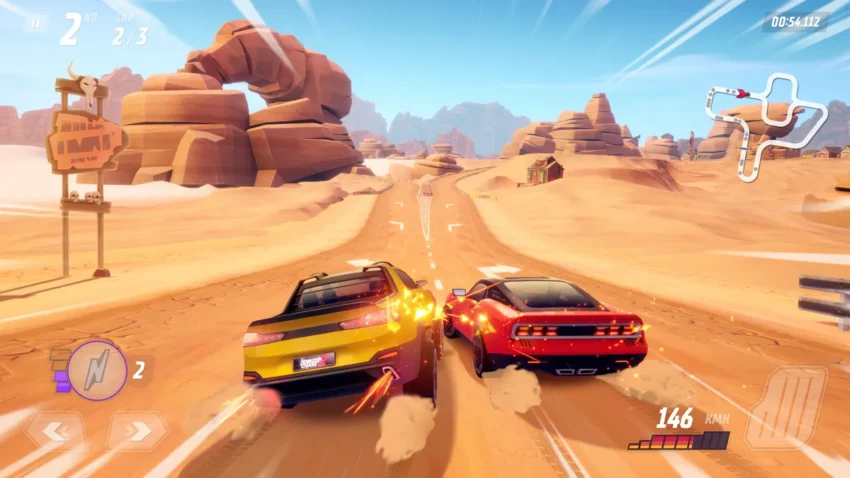
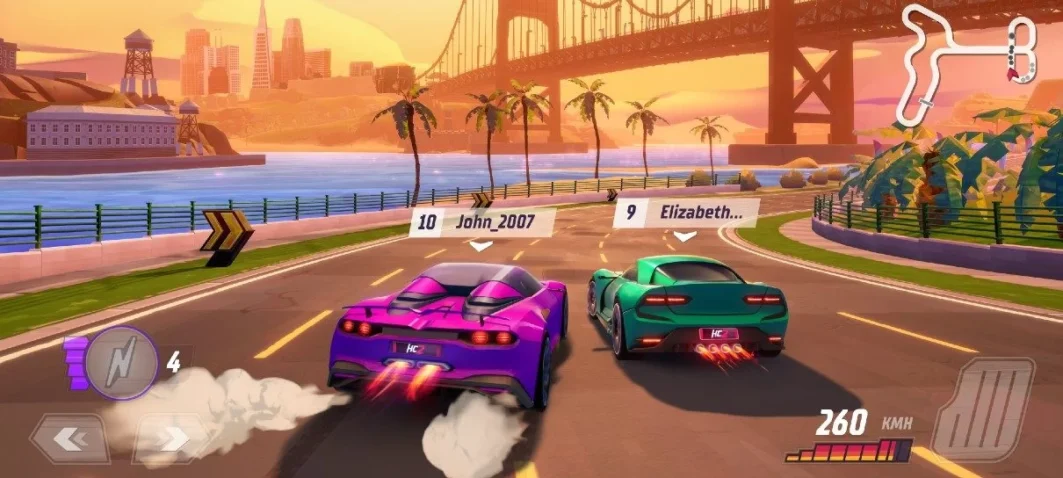
Horizon Chase 2 is the evolution of the award-winning racing franchise, bringing back the true spirit of arcade racing.
Studio: Aquiris Game Studio
Engine: Unreal Engine 4
Platform: Apple Arcade, PC, and Consoles
Launch Date: September 2022
Development Period: August 2020 – July 2023
My Role:
- Contributed to UI implementation and interaction systems
- Developed custom shaders for UI features and dynamic visual behavior
- Helped build and improve asset pipelines, including vehicle integration workflows
- Developed artist-facing tools to streamline car implementation in Unreal Engine
- Prototyped tools to improve track creation workflows for level designers
- Contributed to game-wide optimization efforts
- Worked with Substance, Blender, and Photoshop in support of content production pipelines
- Created Blender tools to automate asset preparation for Unreal Engine integration
UI Examples:
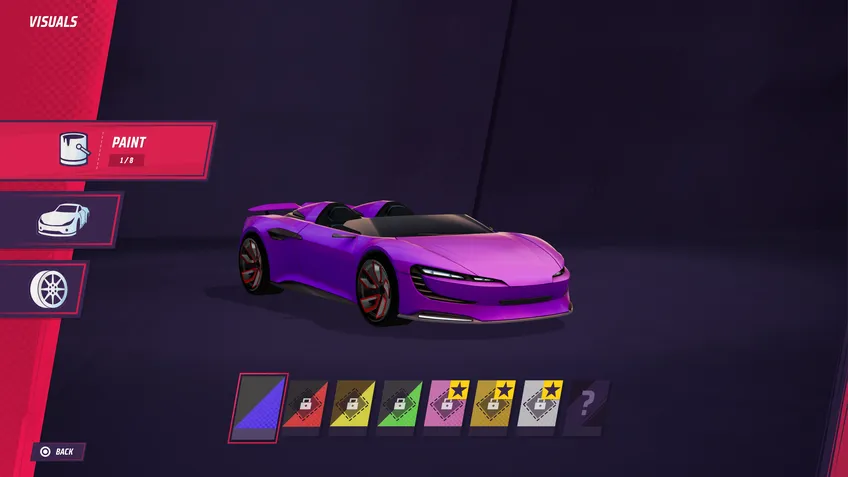
Car Customization Screen:
Worked on screen animations, interactions, and controller navigation behavior to support the intended UI/UX flow. Contributed to maintaining and improving the feature alongside the main implementation owner.
Highlights:
- Implemented dynamic side buttons that update based on car configuration data.
- Designed a reusable base button system for customization of item types, improving maintainability and scalability.
- Implemented dynamic performance bars that adapt to vehicle-specific data.
- Built responsive car status bars driven by gameplay data.
Car Garage:
Implemented animations and UI behavior for the garage experience, including reusable car-part cell variations and a specialized version for car body presentation.
Highlights:
- Created a custom material for locked car bodies, eliminating the need for additional artist-created variants.
- Improved asset reuse while preserving the intended art direction.
Tournament:
Developed a custom shader system for dynamic tournament posters that automatically adapts to configuration data while preserving UI art requirements.
Highlights:
- Enabled poster updates through data-driven configuration with Live Ops compatibility.
- Reduced manual rework when content changes.
- Implemented aspect-ratio handling and animation behavior to maintain visual composition on screen.
Track Selection:
Worked on data-driven track selection poster implementation and associated pipeline improvements.
Highlights:
- Built systems to automatically feed poster assets from incoming data.
- Improved poster formatting pipeline.
- Implemented manual controller navigation to support the intended UX flow.
Starting Line:
This section showcases several states that occur before the race begins, including the track name presentation, countdown sequence, and speedometer feedback used to determine the best possible start. Synchronizing all these elements while maintaining a polished and cohesive presentation was a challenging task.
Optimization Steps:
The starting line sequence required several optimization passes, particularly for Nintendo Switch, due to the large number of vehicles being rendered and simulated simultaneously on screen. To address GPU bottlenecks, I developed and implemented multiple optimization strategies that reduced vehicle complexity whenever cars were outside the player’s immediate focus. These improvements helped lower rendering costs while preserving visual quality during the race start sequence. Additional details about these optimizations can be found in the vehicle optimization section.

Optimizations Examples:
Car Optimization Details:
Our vehicles use a four-level LOD system. LOD0 is reserved for hero vehicles and high-end platforms, while race scenarios primarily rely on LOD1 for the player’s vehicle. The main distinction between LOD0 and LOD1 is the overall geometric complexity and vertex count. To simplify the explanation, the LOD strategy can be summarized as follows:
- LOD0 – Highest-quality version used for hero vehicles and high-end platforms.
- LOD1 – Standard race-quality version with reduced rendering cost while maintaining visual fidelity.
- LOD2 – Removes interior geometry, merges the glass into the vehicle’s primary material to eliminate an additional draw call, and further reduces vertex count.
- LOD3 – The most aggressive optimization level. Vertex count is reduced even further, and wheel geometry is merged into the vehicle body, eliminating wheel draw calls entirely.

In addition to the asset-side optimizations, I collaborated with the engineering team on runtime optimizations that further reduced GPU costs and supported the overall rendering performance strategy.
Gameplay UI Optimizations:
During race gameplay, I worked on several UI optimizations to reduce CPU overhead while preserving responsiveness and visual quality. Some of the key optimizations included:
- Minimap – The minimap was updated using an independent refresh rate rather than matching the game’s simulation tick rate. For example, while gameplay could run at 60 FPS, the minimap updated at 30 FPS, with even lower update frequencies on lower-end platforms when appropriate. This significantly reduced CPU workload, resulting in performance gains of approximately 15%.
- Speedometer Bar and Numeric Display – This was one of the most challenging UI elements to optimize due to its constant visibility and importance to gameplay. Optimization efforts focused on reducing the update cost of the numeric display, which was the most expensive component. Additionally, the speedometer was moved out of the static canvas hierarchy to avoid unnecessary canvas rebuilds caused by per-frame updates. These changes provided an additional performance improvement of approximately 5%.
Links:
- Website: Horizon Chase 2